Evaluate AI as One Team. Deploy Software with a Defensible Record.
AITPRM Health unites IT, clinical leadership, legal, and procurement in a single workspace to assess, monitor, and manage third-party AI risk across the entire care continuum.
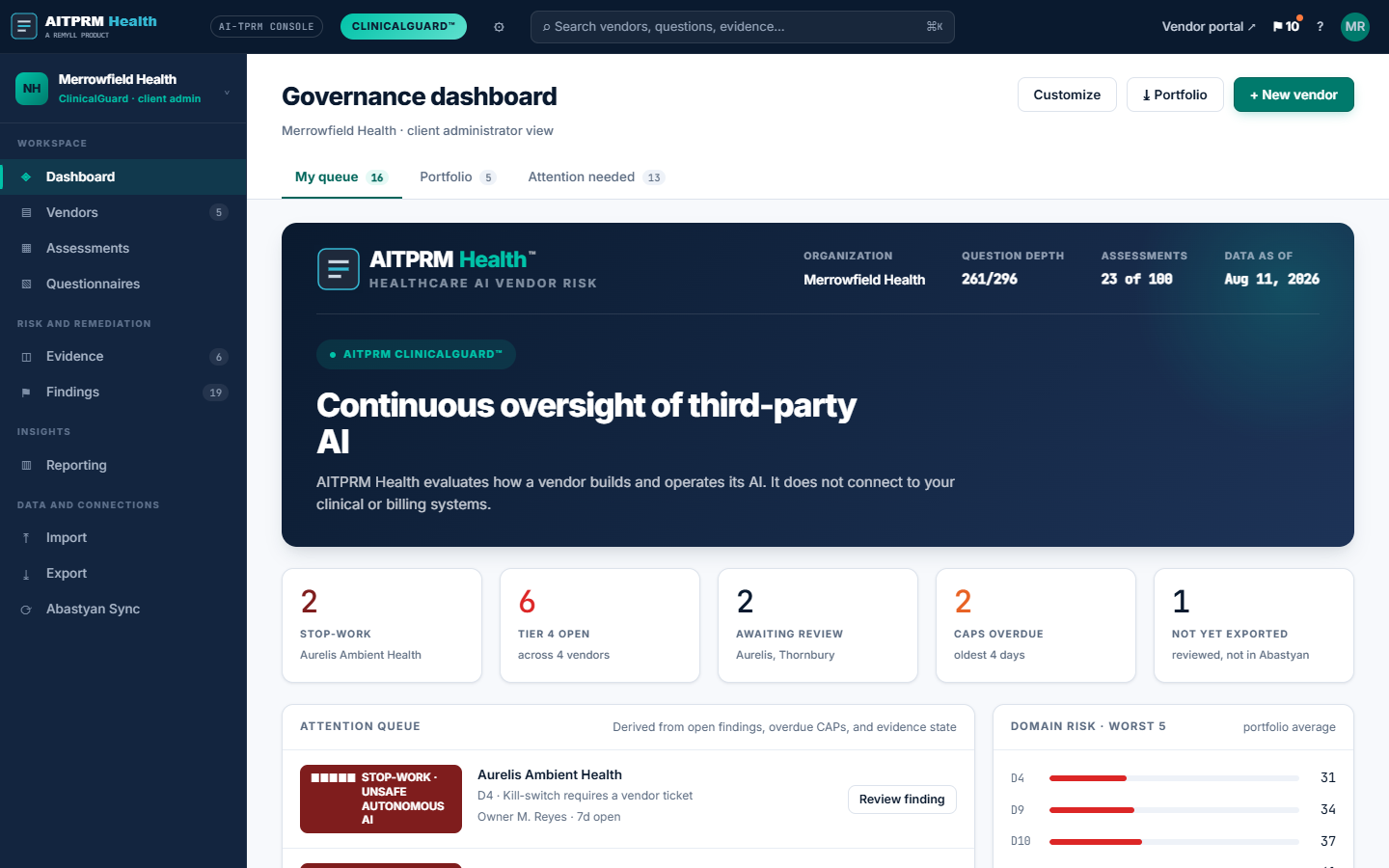
AITPRM Health supports organizations across the healthcare continuum.
Nine segments, one method. Each card names the AI tools that segment is most likely to be evaluating this year.
Hospitals and Health Systems
Govern clinical decision support, ambient EHR scribes, and predictive risk tools across complex multi-facility networks.
How it applies →Physician Groups and Clinics
Fast-track safe adoption of clinical documentation and patient messaging AI without requiring a dedicated IT risk team.
How it applies →Behavioral Health Providers
Protect sensitive mental health records and ensure AI tools maintain proper clinical boundaries and human oversight.
How it applies →Post-Acute and Senior Living
Safely evaluate remote monitoring systems, fall-prediction algorithms, and automated care-plan recommendations.
How it applies →Home Health and Hospice
Secure mobile AI workflows, field documentation tools, and predictive care-escalation engines.
How it applies →Payers and ACOs
Audit prior-authorization algorithms, population health models, and claims automation for fairness and clinical necessity.
How it applies →Dental Groups and DSOs
Assess AI-driven radiologic imaging, treatment planning software, and automated patient scheduling tools.
How it applies →Health Technology Vendors
Map third-party AI supply chains (AI-SBOM), secure PHI pathways, and generate verifiable readiness scorecards for enterprise procurement review.
How it applies →First-Time Governance Builders
Establish a structured, repeatable AI vendor review workflow from scratch without starting from a blank spreadsheet.
How it applies →Built for shared organizational responsibility: Procurement · IT and Security · Clinical Leadership · Legal and Risk
See how each role reads the record →The vendor runs the model. Your organization carries the obligation.
Three shifts a security questionnaire and a BAA review were never designed to catch. Each reduces to a question you can put to any AI vendor in writing, before signature.
Non-delegable liability
A vendor may run the model, hold the data and manage the infrastructure. Under HIPAA and state law, your organization still answers for how the tool is used.
Which of these obligations have you assumed in writing, and what happens if you cannot meet them?
HIPAA 45 CFR 164.308(b), 164.504(e)Aggregate accuracy vs local performance
A model validated on national data may perform differently for your population, your documentation patterns and your care setting. Vendors report the average.
What performance do you report by subgroup and by site, and for which populations was the model validated?
ONC HTI-1 source attributes · D4The hidden AI supply chain
Behind the vendor sits a foundation model provider, a hosting environment and a chain of subprocessors. Standard BAAs rarely name them.
Name every model provider and subprocessor in the chain, with the agreement that binds each one.
45 CFR 164.504(e) · D2Three steps. One record.
Each step has a defined input, a defined output and a named owner, so a review can be handed to a colleague without losing the thread.
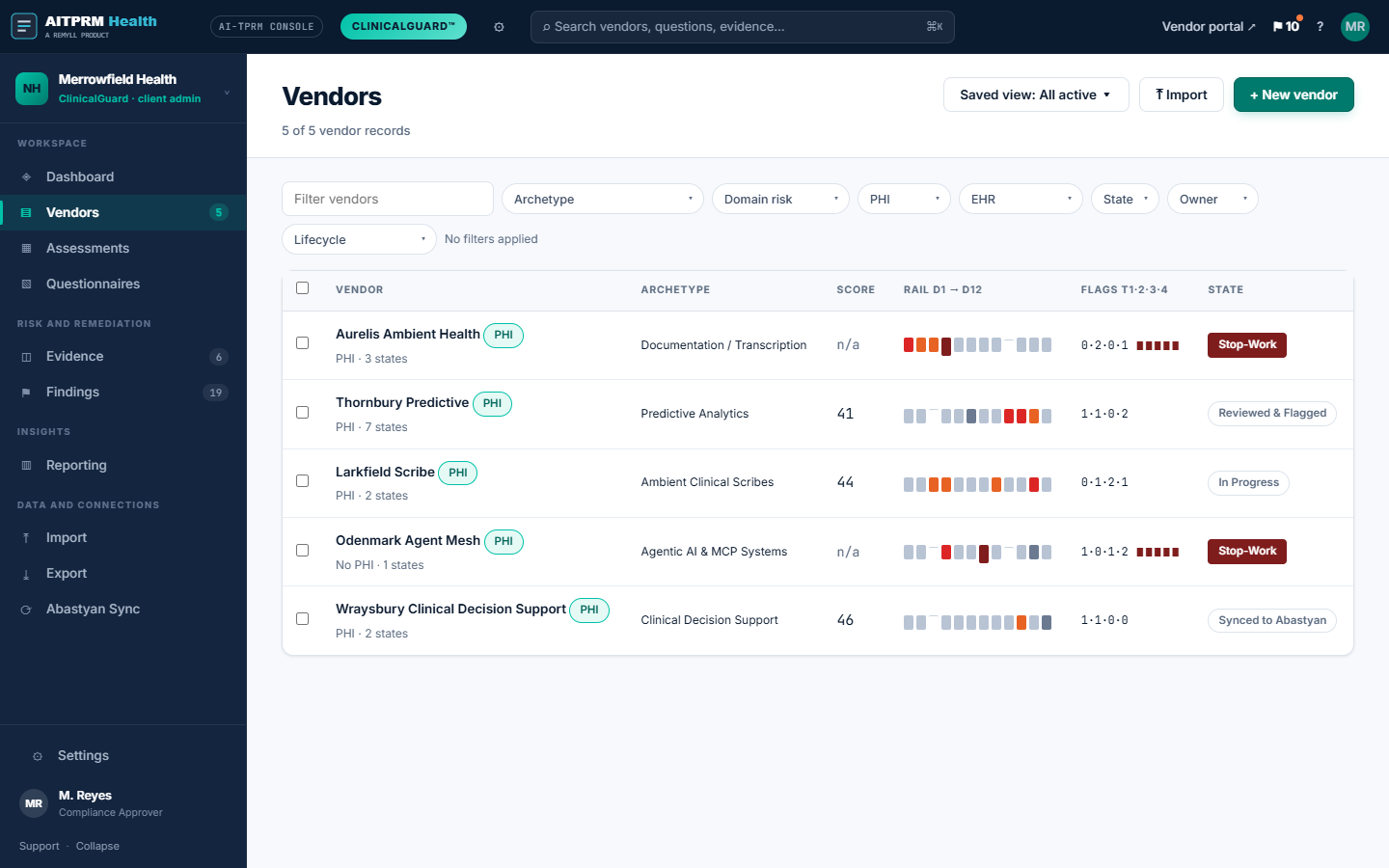
Illustrative. Sample data shown.
Six deployment facts scope the review. The vendor answers only its set.
The scoped question set and state overlays go to the vendor through the portal; response time depends on the vendor and the documentation it has on hand.
Continuous Drift & Workflow Governance
A model approved at contract signing decays as patient populations shift and unannounced vendor updates land. AITPRM Health manages ongoing algorithmic performance across three core controls:
Illustrative. Sample data shown.
Five evaluation domains. Overlays applied by where you operate.
Every vendor is assessed across the same five areas. Statutory overlays for HIPAA, HTI-1, CMS coverage policy and state AI acts are selected during scoping, based on your organization’s location, care setting and the tool’s intended use, so the question set reflects the deployment under review.
Model Provenance
Training data origin, output generation, and whether updates alter core functions.
Drift and Safety
Operational thresholds for accuracy, monitoring, and manual fallback when tools need human review.
Data Privacy and Security
Zero data retention, isolated environments, and exclusion from secondary model training.
Bias and Equity
Subgroup performance and local validation across populations and care settings.
Audit Rights and Indemnity
Balanced liability boundaries, inspection rights, and access to performance logs.
AITPRM Health sits alongside your existing security and legal review and covers the AI-specific questions neither asks.
Operational guidance for healthcare AI decisions.
Briefs from the AITPRM Health Governance Lab for the leaders accountable for third-party AI risk. Open access. No gates.
See a Scoped Review in 30 Minutes
Explore a complete evaluation in a guided 30 minute walkthrough using standard clinical and administrative AI reference models.
Prefer to read first? Explore the 2026 AI Renewal Guide or download the sample scorecard.